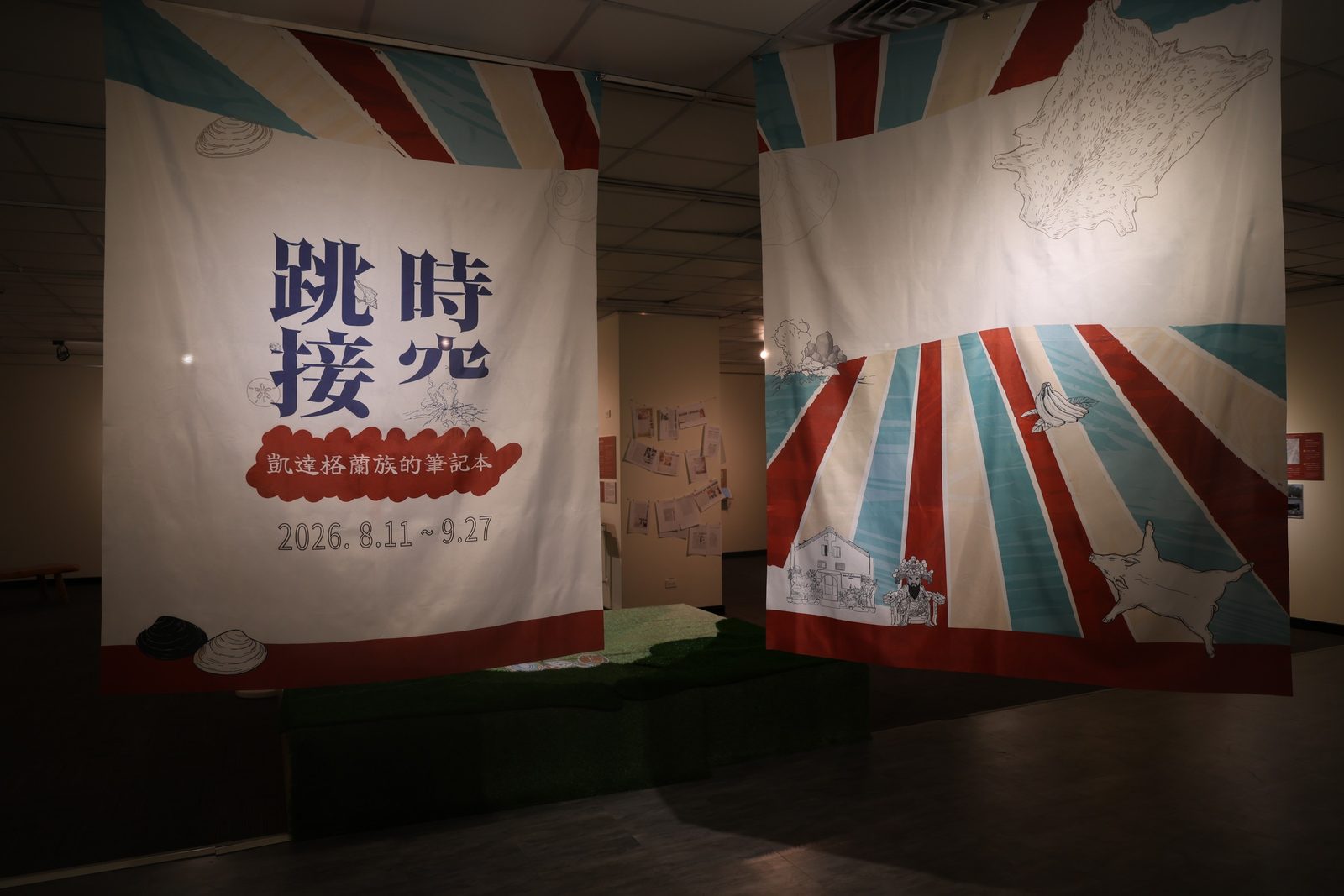
Splicing Time: A Ketagalan Notebook
Open the online tour in full screen
Have you ever wondered what has happened on this land since the seventeenth century? From the arrival of the Spanish and the Dutch in northern Taiwan, through Qing rule and Japanese colonization — do the people, the language, and the wisdom of the Ketagalan still quietly persist in our daily lives today? The Ketagalan are an Austronesian people, among the earliest inhabitants of the greater Taipei area. Because their ancestors left no written script, this exhibition works to piece together a picture of their past lives through the records left by foreign regimes.
In contemporary understanding, the Ketagalan are often labeled as “already vanished,” or as “Sinicized” through centuries of contact. Yet culture has never been a specimen held still. It is a great river, flowing continuously through the exchanges, adaptations, and transformations of each era. History shows us that culture does not simply disappear or dissolve into something else — it traces a path of ongoing continuation, reconstruction, and creation amid change. What this teaches us is that a sense of belonging to the land should never be confined to ethnic identity. It is built gradually, through understanding historical truth, recognizing cultural diversity, and drawing on the lived experiences we all share.
The exhibition follows six thematic threads, drawing fragments of memory out of a dense body of historical documents and field records — and leaving the pleasure of assembling the puzzle to each visitor. Alongside the displays, a program of activities led by Ketagalan descendants gives the exhibition further dimension, offering the public a chance to feel the vitality passed down through generations. The Ketagalan do not exist only in archives. They live among us, in the present, in an act of cultural revitalization that is happening right now.
We warmly invite you into this exploration across time. Follow the footsteps of our little guide spirit — the Tiger God Who Pretends to Be a Cat — and set out on a path of shared learning with no age limit and no final destination. Come and meet again the Ketagalan people who once lived, and who still live, on this land.
Ready for a journey full of surprises? Sjana-i maw! (Basay: Go play! / Explore to your heart’s content!)
Six thematic zones
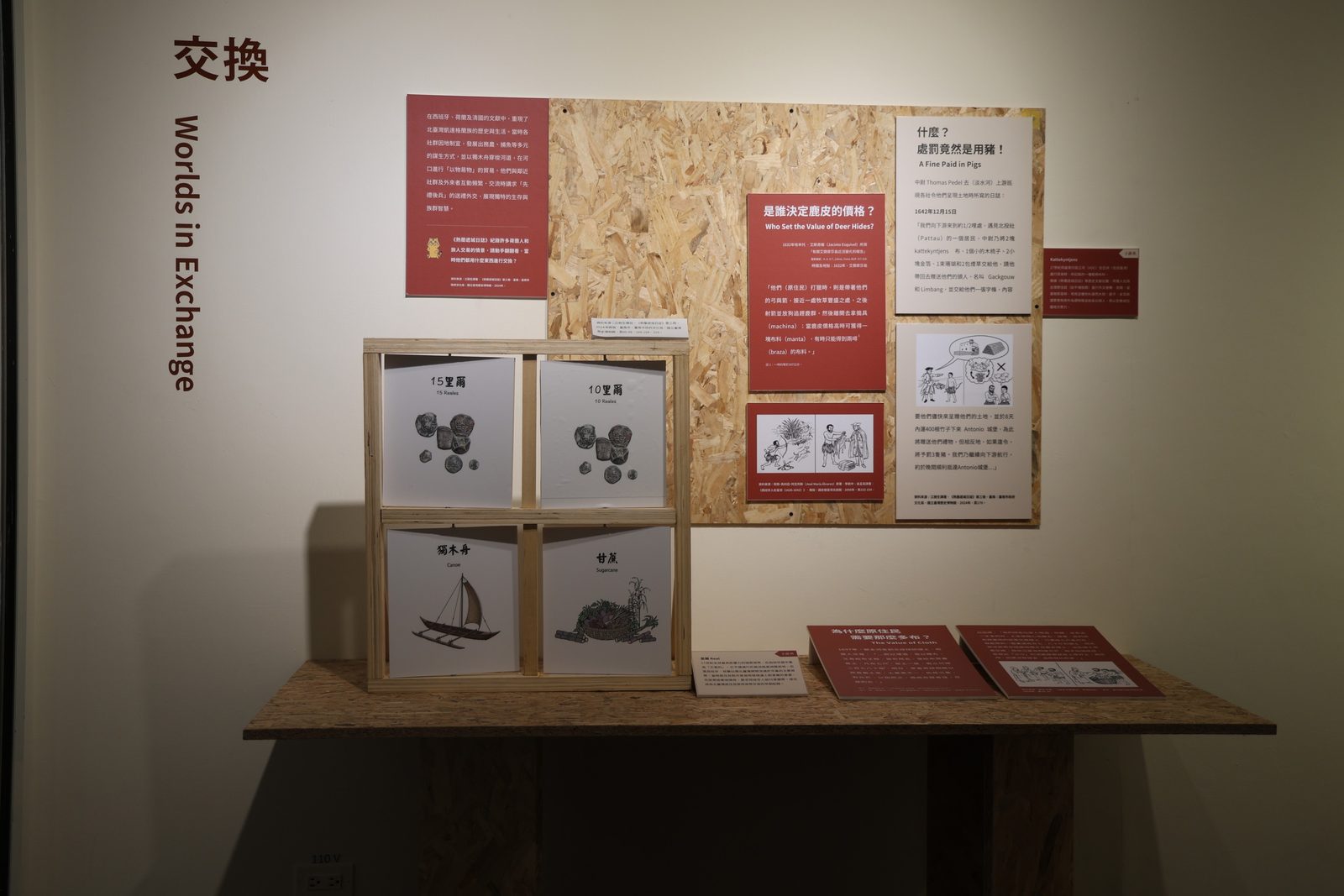
Zone 1 · Worlds in Exchange
Spanish, Dutch, and Qing records bring the history and daily life of the Ketagalan of northern Taiwan back into view. Each community adapted to its surroundings, making a living by farming, fishing, and other means; people paddled dugout canoes along the rivers and bartered goods at the river mouths. In frequent dealings with neighboring communities and with outsiders, they practiced a diplomacy of gift-giving that put courtesy before force — evidence of a distinctive wisdom, both for survival and for living among other peoples.
Zone 2 · Dining by Hand
This section presents the foodways of the Ketagalan, shaped by a life lived in harmony with nature. Living along the rivers, the Ketagalan stewed taro, sweet potatoes, and meat together in shallow earthenware pots, and ate with their hands.
Zone 3 · Sulphur
Geological activity in the Tatun Volcano Group endowed Beitou and Yangmingshan with abundant sulphur, with deposits at Dayoukeng, Sihuangziping, and elsewhere. More than a natural product, sulphur was essential to gunpowder and to industrial development. From the Spanish and Dutch eras through the Qing Empire to Japanese rule, it remained a strategic resource contested by successive regimes.
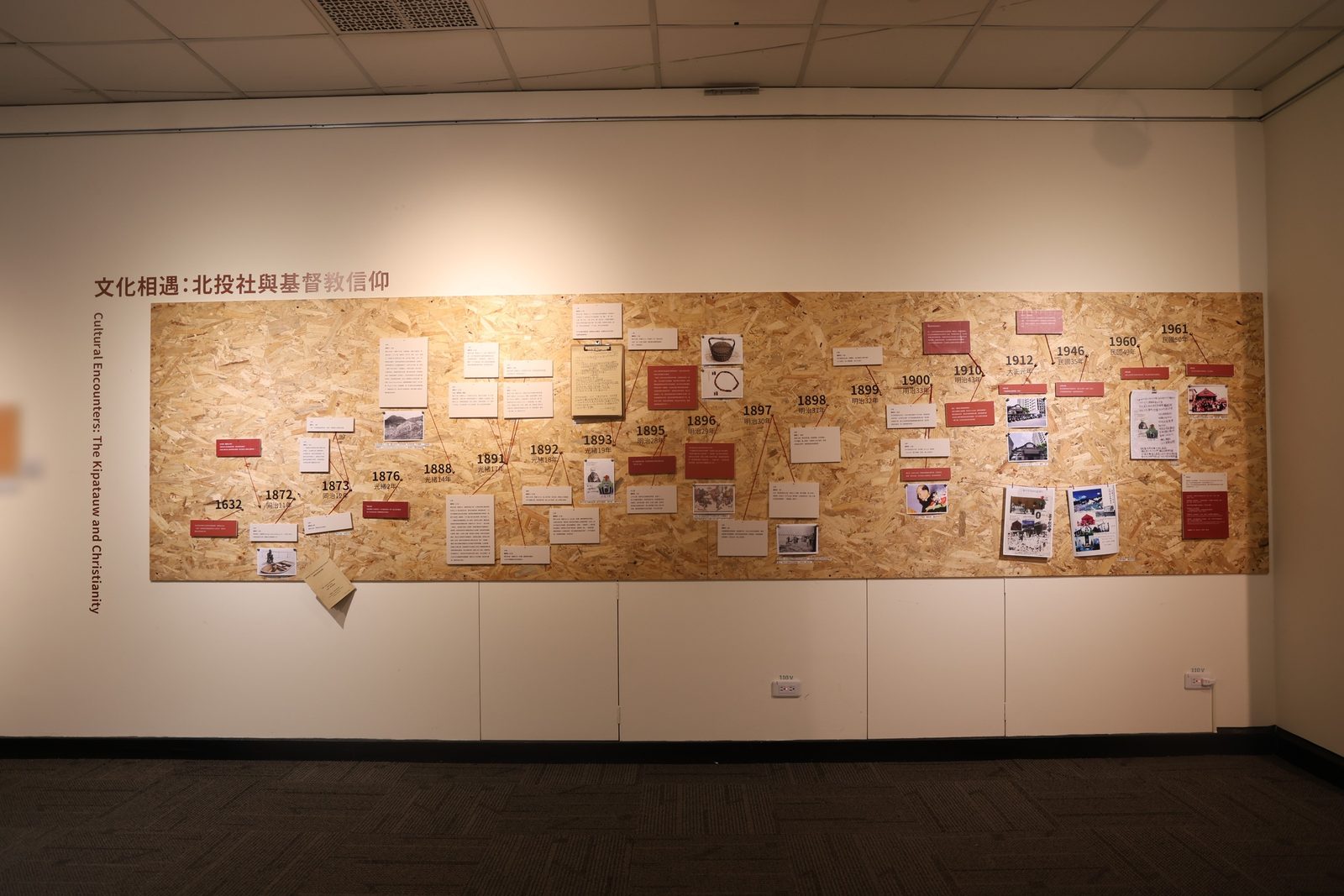
Zone 4 · Cultural Encounters: The Kipatauw and Christianity
This section retraces a century of mission history shared by the Rev. George Leslie Mackay and the Ketagalan believers of Kipatauw. Drawing on The Diary of George Leslie Mackay, the records of Ino Kanori, and the story of how the Beitou church was founded, it follows Mackay’s footsteps in Beitou — founding a chapel, performing baptisms, and visiting the sulphur hot springs, among other valuable observations — as well as Ino Kanori’s encounters with, and observations of, the headman of Kipatauw. Together with handwritten records by Pan Liang Fen-ying, a descendant of the Kipatauw, and materials from Chen Chin-wan and from Chen Kun-mu, former secretary of the Taiwan Pingpu Association, it shows how the Christian faith took root and grew ever deeper in Beitou. To this day, members of the Kipatauw community still return here every Sunday to worship. Documents on the timeline wall, including the original English manuscript of Mackay’s diary and Pan Liang Fen-ying’s handwritten notes, are available for browsing.
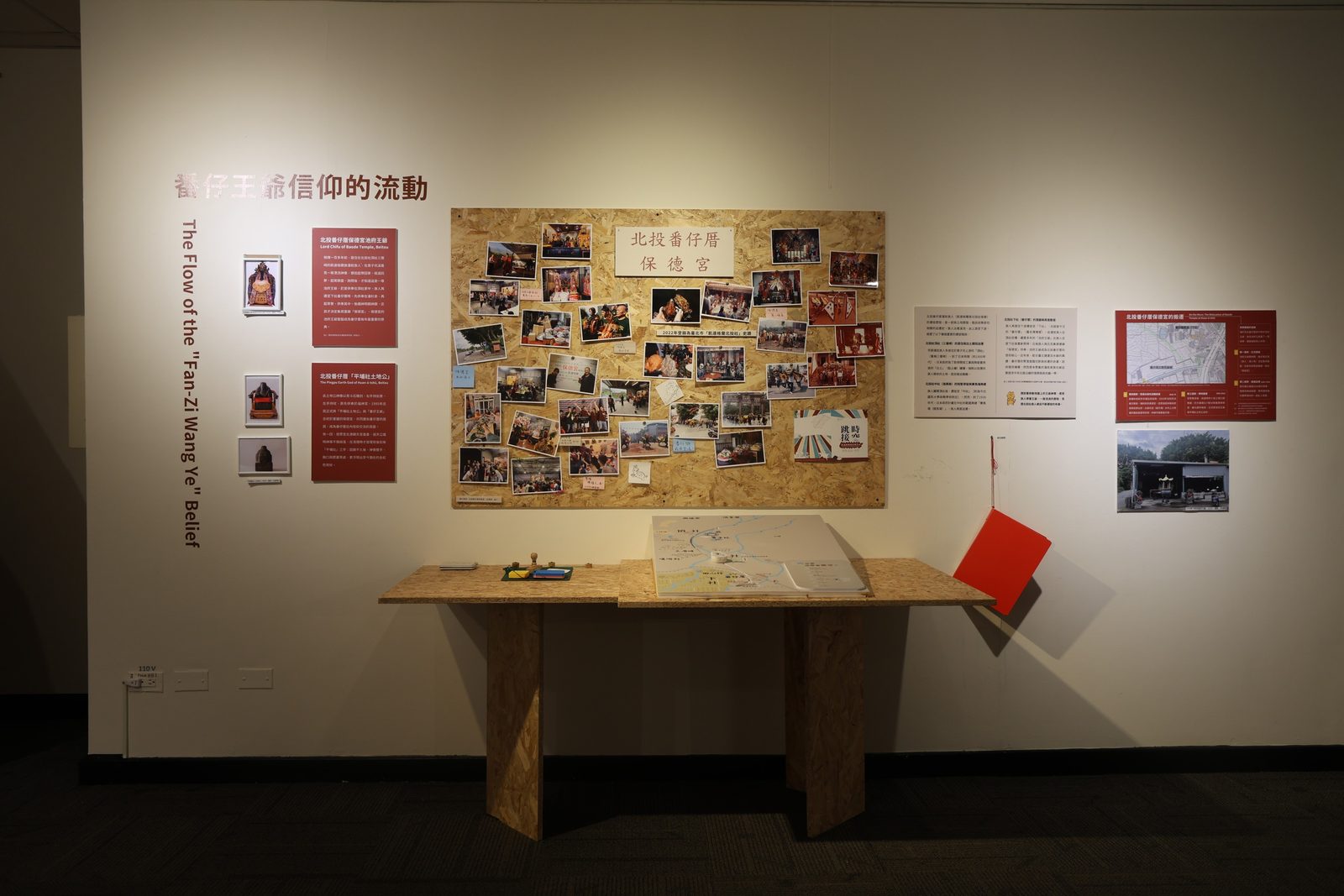
Zone 5 · The Flow of the “Fan-Zi Wang Ye” Belief
This section focuses on Fanzihcuo in Beitou, the community of worship centered on Lord Chi (Chi Wangye) of Baode Temple. By following Lord Chi’s journeys with the temple, it traces the lives of the Ketagalan of Kipatauw. The legend of the “Fan-Zi Wang Ye” being “picked up from a stream,” and an Earth God statue carved on its back with the words “Pingpu She” (“Pingpu Community”), bear witness to the deep intermingling of Indigenous and Han beliefs. Migration maps and historical photographs show how the settlement and Baode Temple were forced to wander from the upper settlement to the middle and then the lower, displaced by white-clay mining and a racecourse in the Japanese era and by construction of the modern MRT. Together with records of the “Fan-Zi Lion” dance troupe, Lord Chi’s birthday celebrations, pilgrimages, and other rites, the section reveals the cross-ethnic cultural resilience of the Fanzihcuo community and the traditions it has handed down through generations.
Zone 6 · Ritual Drinking and Cultural Revival
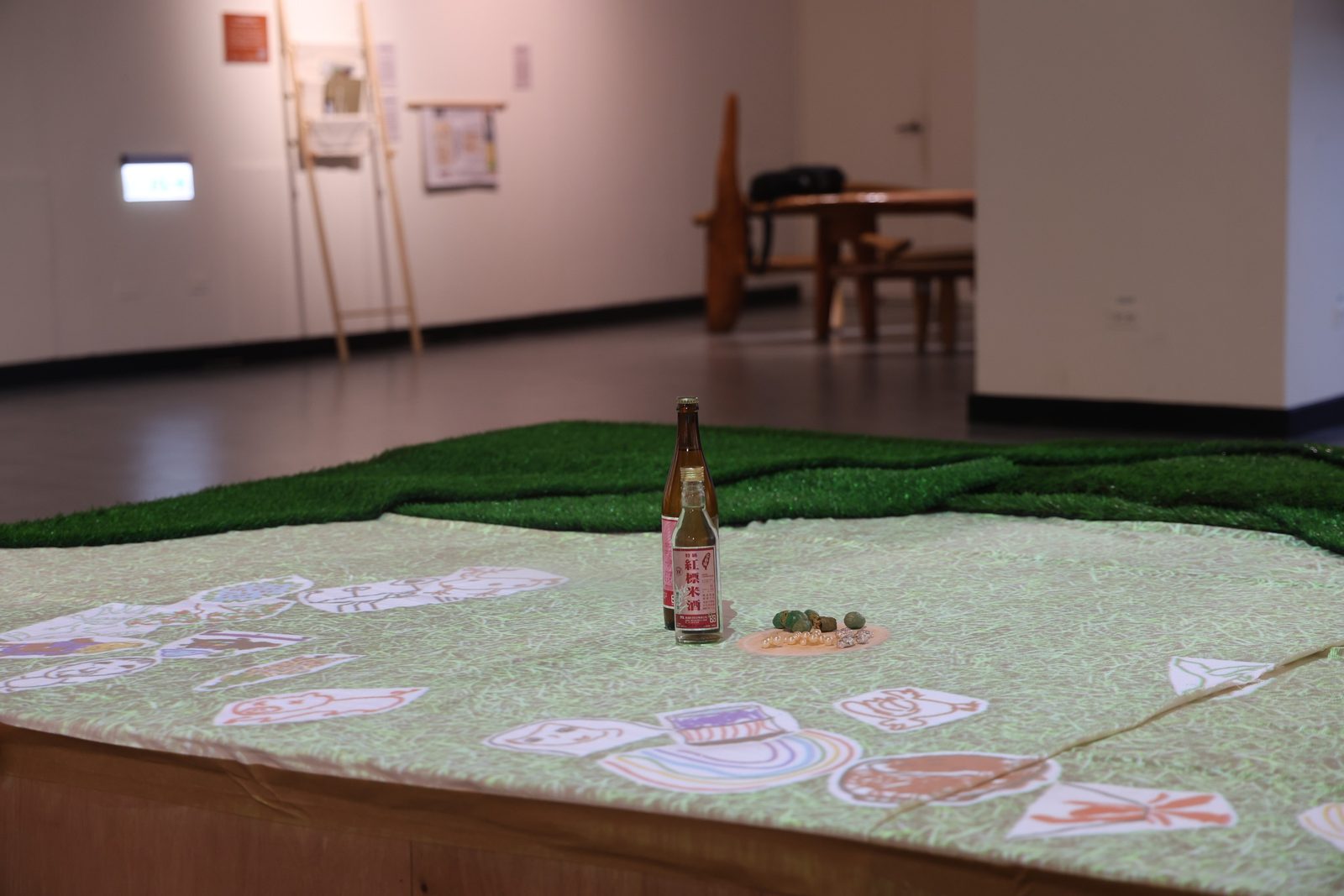
Seventeenth-century Spanish priests recorded that when the rice came into ear, and again at reaping and harvest, the Ketagalan held a ritual drinking gathering lasting three days and three nights, called masitanguitanguich. During the gathering, people set everything else aside to sing and dance to their hearts’ content, drinking freely of machina, a pounded brew kept in small jars.
Interactive projection: 尋根會飲
Draw an offering and present your blessings to the ancestral spirits. Draw freely on the tablet, or use a template to create an offering of your own; your finished offering will be projected onto the grass, re-creating the devout spirit in which the Ketagalan invite their ancestors to the feast.
Zone 7 · Reading Corner and About Tree Tree Tree Person
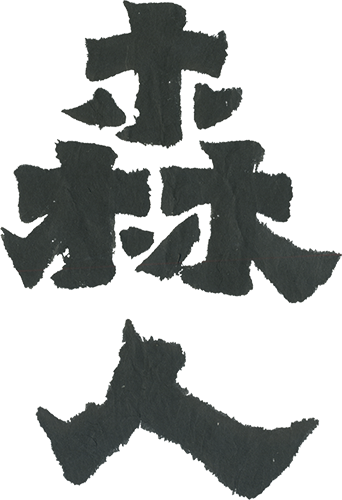
Initiated by Chen Cheng-tao in 2015, Tree Tree Tree Person centers its practice on artist residencies. Setting out from the Datong and Dali villages in Taroko, Hualien, it explores the deep connections between people and nature, and between land and memory. In 2018, at the invitation of the Hong-Gah Museum, Tree Tree Tree Person began to engage with the stories of the land of the Ketagalan Kipatauw. In 2020, the Tree Tree Tree Person – Beitou team (Su Po-chi, Chen Cheng-tao, Tseng Yun-chieh, Hsu Chia-jung, and Liu Shan-shan) gradually took shape and launched the Tree Tree Tree Person – Beitou Art Residency. Over the years, with Baode Temple in Fanzihcuo as its base, the team has brought together local faith communities, cultural historians, and artists. Through art-making, field writing, workshops, talks, and walks, it follows the grain of this land to trace the lives of its nature, its people, and its Pingpu communities.
Dates | 11 August – 27 September 2026
Venue | Ketagalan Culture Center (No. 3-1, Zhongshan Rd., Beitou Dist., Taipei 112)
Organizer | Indigenous Peoples Commission, Taipei City Government
Sponsor | Department of Cultural Affairs, Taipei City Government
Exhibition Advisor | Peng Ling
Curatorial Team | Tree Tree Tree Person (Chen Cheng-tao, Tseng Yun-chieh, Liu Shan-shan, Hsu Chia-jung, Su Po-chi)
Exhibit Materials Courtesy of | Baode Temple of Fanzihcuo, Beitou; Lu Li-chang; Chen Kun-mu; Peng Ling; Pan Liang Fen-ying (listed in order of Chinese stroke count)
Voice | Pan Liang Fen-ying
Text Review | Peng Ling; Chen Kun-mu (in part); Chen Chin-wan (in part)
Special Thanks |
Baode Temple of Fanzihcuo, Beitou; Independence Presbyterian Church in Xinbeitou (自立長老會新北投教會); Hong-Gah Museum, Chiu Tsai-hsing Cultural and Educational Foundation; Ying-yi Golden Lion Troupe of Fanzihcuo, Beitou; Zijiren Co., Ltd.; Aletheia University History Museum; Shung Ye Museum of Formosan Aborigines; Pan Kuo-liang; Pan Liang Fen-ying; Chen Kun-mu; Wu Chih-ching; Hsu Kun-ting; Chao-heng Household Hardware Wholesale, Bali; Little i’s Early Bird Paradise
The Tiger God Who Pretends to Be a Cat is modeled on the Tiger God statue enshrined at Baode Temple in Fanzihcuo, Beitou.
Installation photographs | Tree Tree Tree Person